
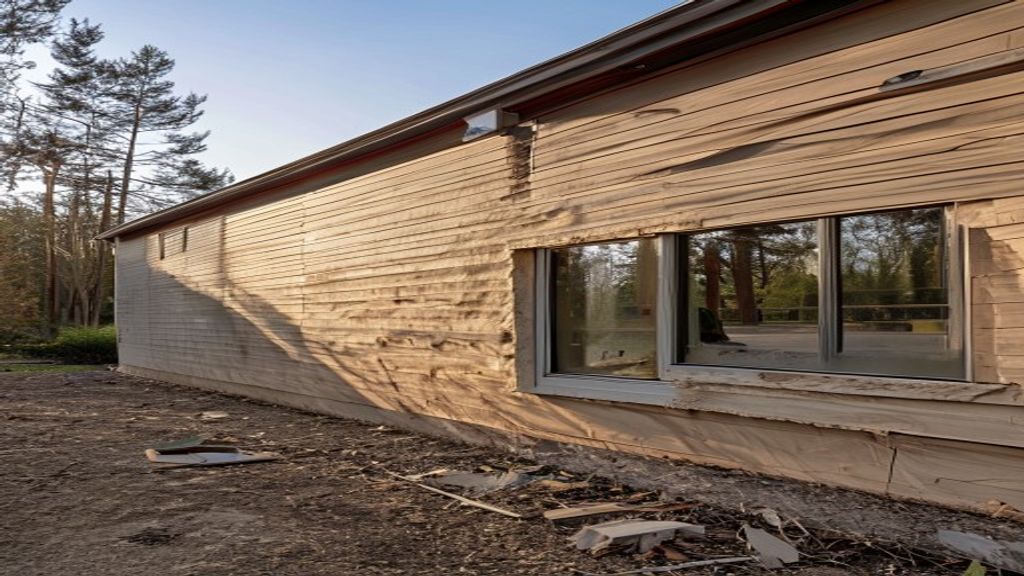
Green Building Advisor ran a piece asking whether drainable housewraps are enough to keep a wall assembly dry. The short answer: they help. The complete answer is more complicated — and it matters every time Beckett Real Estate walks a house built in the last fifteen years.
Here is what the article gets right. Standard housewrap — the flat, non-drainable kind — creates a capillary connection between the back of the cladding and the sheathing. Water that gets behind brick, lap siding, or stone veneer does not drain; it sits. Drainable housewraps introduce a textured or spacer layer that breaks that contact and lets gravity do its job. That is a meaningful improvement over the baseline.
Here is what the article gets right that most buyers and sellers do not know. Drainage is one leg of a three-legged stool:
1. Drainage — water that gets in needs a clear path out before it contacts the sheathing long enough to cause rot or mold. Drainable housewrap addresses this leg. 2. Water-resistive barrier integrity — the housewrap itself, and every penetration through it (windows, doors, utility rough-ins, hose bibs), has to be flashed correctly. A drainable housewrap with a poorly flashed window head is still a wet-wall problem waiting to happen. Twenty years of construction work across residential and commercial builds taught Beckett Real Estate exactly where the flashing fails: above window headers, at the transition from housewrap to pan flashing, and anywhere a subcontractor lapped the wrong direction. 3. Drying potential — a wall assembly needs to be able to dry to at least one side. In Georgia's mixed-humid climate (IECC Zone 3), walls typically dry inward in summer and outward in winter. Close the interior with an impermeable vapor retarder — say, kraft-faced batts installed vapor-side out — and you have eliminated the drying path the wall needs most. Drainable housewrap on the outside does not fix a vapor management problem on the inside.
Why does this matter when buying a resale in metro Atlanta?
The bulk of the residential resale inventory in this market — Newnan, McDonough, Woodstock, Gwinnett, Cobb — was built between 1995 and 2015. That window catches two back-to-back generations of builder practice: the flat-wrap era and the early drainable-wrap era. Neither generation consistently got window flashing details right at scale. When production builders were running twelve to eighteen houses simultaneously, flashing sequencing was the detail most likely to get cut or reversed by a framing crew moving fast.
The signs show up on the building itself if you know what to look for. Efflorescence on brick veneer below window sills. Soft OSB sheathing visible at corner trim gaps. Interior drywall staining that tracks the window rough opening rather than the roof line. Paint peeling from the inside of exterior walls. None of these are cosmetic issues. All of them trace back to the three-legged stool — drainage, barrier integrity, drying potential — failing somewhere.
A drainable housewrap is the right starting point. It is not the finish line.
Send the address. If Beckett Real Estate is walking the property, the wall assembly gets the same read the mechanical systems do — because the repair costs are in the same range when it goes wrong.
Looking in Newnan?
Beckett Real Estate works Newnan end-to-end — active listings, off-market opportunities, and the construction-trained walk-through that tells you what the price reflects vs. what it papers over.
Browse Newnan listings → · Schedule a tour with Beckett Real Estate